A great weariness has settled in my bones, so have some musings about the building blocks of art.
Isn’t art great?
Oh, this form of expression that goes beyond words to investigate the human condition, to create emotional space in a dimension that words could only travel in when woven only just so.
When writing sentences like the above, please know that I think there is a huge chasm between language as a communication device and prose or poetry. Language as an efficient way to transfer thoughts and feelings is a horrendously broken tool. By its nature, it defies any attempt to instil it with emotion or empathy, and so what a victory it is when a book or poem manages to capture anything other than raw information in the face of this stodginess.
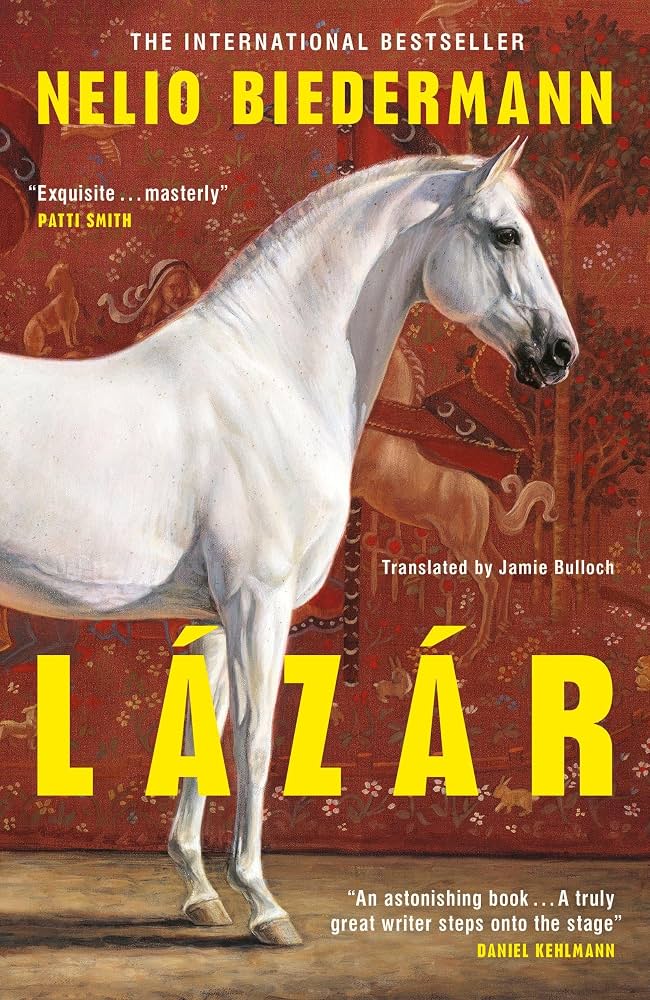
This thought brought to you courtesy of my finishing of Lazar, by Nelio Biedermann. The novel tells the story of a Hungarian noble family and its trials and travails throughout the late 19th and first half of the 20th century. Much to my point, I could write a synopsis of the plot here and completely miss the point of the book. Suffice to say, the way the story paints pictures of its characters as full human beings, all facets illuminated, going through life and letting it shape them is engaging throughout. Empathy is at its core, despite the at times heinous acts that occur.
The beauty of art is that, foundational, it is more than the sum of its parts. As a writer, to engender a feeling, one cannot just state a fact and expect the reader to feel a specific way about it. You have to circle the fact, not approach it head on, but create a nest for it out of context. It’s the context, the surroundings of the fact, that evokes the wanted emotional response.
In a way, the same can be said of any art form. A painting is not a great painting because of the brushstrokes. It’s how the strokes, the colours, the intent of the artist, the place of its viewing all interact. It’s why seeing a painting in the flesh can and forever will be more impactful than seeing it on a screen, or even printed in a book.
I like Van Gogh as much as the next guy, but it wasn’t until I saw his work with my own eyes that the magnitude of his achievement became clear to me. These rough, broad strokes, the bold colours – everything about his works comes to life in front of you. And I’m certainly not a connoisseur of art like this, but I know what I felt.
We could go on: music, film – all things that can only be achieved by not just communicating raw information, but by carefully building a world in which a specific truth can live so it can be transferred to others. This is the craft.
The context can of course also be external.
(My assumption, dear reader, is that you of course understand this better than I do, but allow me the anxiety of someone not taking my point.)
Take punk rock – maybe the most direct and simple form of rock music, does it invalidate my point? I would argue that its directness is a response to and conversation with other musical genres, genres that perhaps got a bit up their own asses1. So the entire form requires the context of the world around it to be able to appreciate it.
Now, let me take a moment to apologise about making this about AI again, it’s been on the brain lately, but AI could never create unique context because it does not have experiences. All AI can do is regurgitate older works to us. Sure, it can mix and match and might come up with something that we as humans could read something into, but it never meant to do that. Which, in turn, means that any AI-written "creative" writing is hollow by definition.
When I read the work of mr. Biedermann, I’m reading the circles of context he’s laying out for me, drawn from his experiences of being a human being. It connects me to him, because those experiences overlap with mine and thusly we create an understanding through the written word about what is happening to the people in his story.
A chatbot could output something that emotionally I could be hit by, but that reaction is only one way and it’s because of how I interpreted that output. With the work of a human, it goes both ways, it’s two pieces of a puzzle connecting rather than one piece simply neatly fitting into a slot that was machine-designed to fit that piece.
The thing that saddens me is not that AI can attempt to fool me in pretending to make something profound, or that it most likely sometimes does. It’s that anyone would think it’s the same experience.
1Oh, the irony!